
Why Your Business Needs a Memory
The Knowledge Loss Problem Nobody Talks About
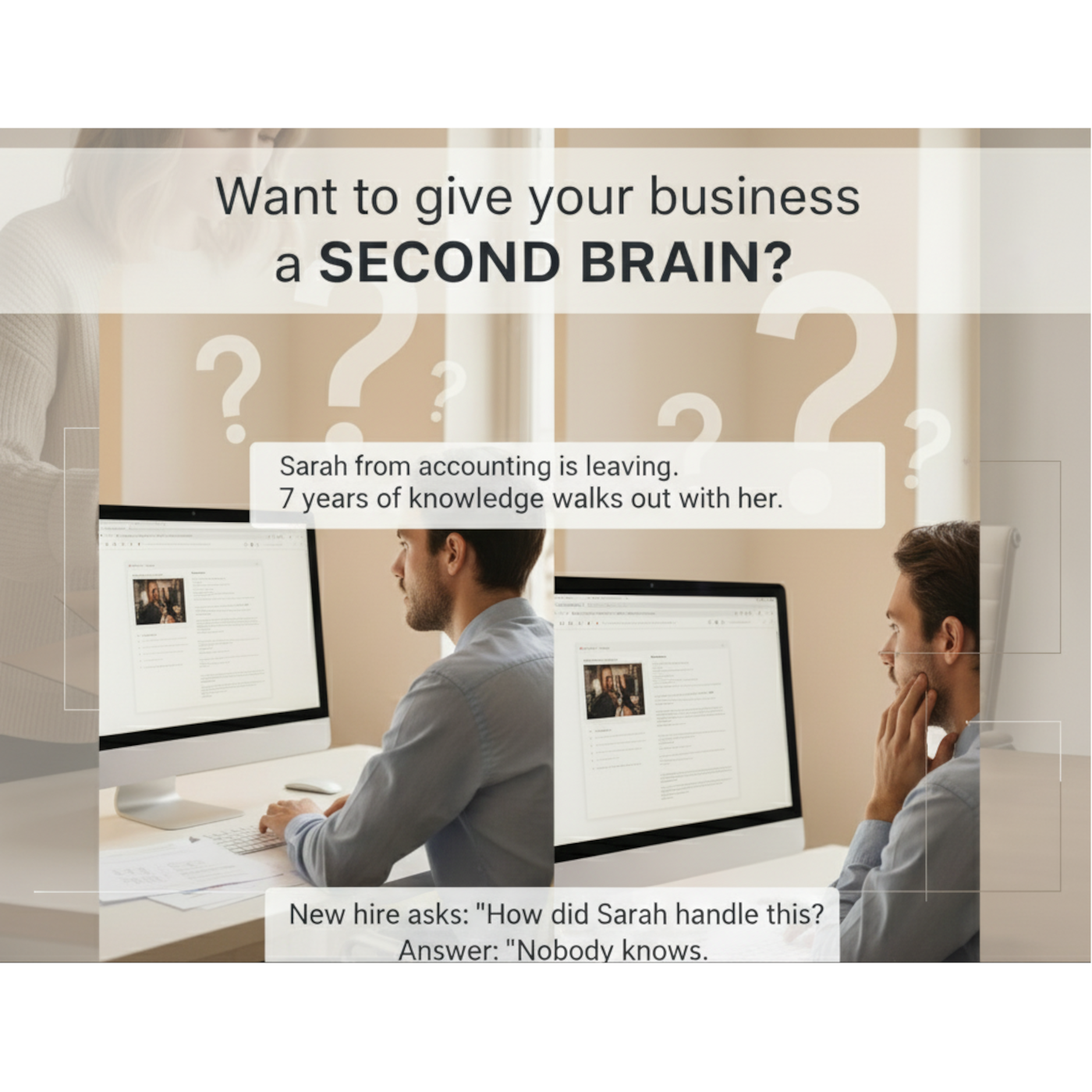
Sarah from accounting just gave her two weeks notice.
She's been with your company for seven years. Seven years of knowing exactly which vendors to negotiate with, which payment terms actually work, which client issues need escalation, and which can be handled with a simple email.
Seven years of "institutional knowledge" that exists nowhere except in Sarah's head.
And in two weeks, it walks out the door with her.
The new hire will ask: "How did we handle this last time?"
The answer: "Um... I think Sarah did something with that vendor, but I'm not sure exactly what worked."
This happens in every business, every day. The real cost isn't just the rehiring expense—it's re-learning everything from scratch.
It's Not Just About Turnover
Even with completely stable teams, knowledge gets lost:
- "We tried that marketing approach a couple years ago... or was it three? How did it actually perform?"
- "I know Tom figured out that client situation, but he's on vacation for two weeks."
- "Let me dig through six months of old emails to find that pricing decision and why we made it..."
2-4 hrs
Per Week Searching
6-12 mo
New Hire Ramp Time
100%
Knowledge Lost at Exit
Every employee spends hours searching for "what we learned before." Different people make similar decisions differently. Nobody has the complete picture.
What We Built: A Second Brain, Not a Replacement
Let's be crystal clear about what this is and isn't:
This Is NOT:
- Employee surveillance
- Job automation
- Replacement for human judgment
- AI making decisions for you
This IS:
- Institutional knowledge capture
- Second brain for every employee
- Safety net when people leave
- Faster access to past learnings
Think of it this way: Every employee having perfect recall of every decision ever made in their domain.
How Sarah Benefits (While She's Still Here)
Real Scenario
Sarah's negotiating with a new vendor. Instead of relying on memory, she searches the system:
"Last 8 times we negotiated with this vendor type, offering Net-30 with 2% discount closed the deal. Net-60 resulted in 6 months of back-and-forth."
Result: Sarah closes the negotiation in one email. Confident, fast, effective.
How the Team Benefits (When Sarah Leaves)
Knowledge Preservation
New hire starts. Day three, vendor negotiation comes up. They search the system and instantly have access to Sarah's seven years of experience—what worked, what didn't, and why.
Result: Six-month learning curve becomes six weeks.
How It Actually Works (No Hype)
The system is straightforward: Track decisions → Record outcomes → Surface patterns
For Different Roles Across Your Business
Sales Team
Captures: Every pricing negotiation, proposal approach, objection handling
Surfaces: "Premium tier pricing closes 87% of deals vs. 13% for budget pricing"
Impact: New sales people have veteran knowledge from day one
Marketing Team
Captures: Every campaign strategy, content approach, channel experiment
Surfaces: "Email strategy A: 18% conversion. Strategy B: 47% conversion"
Impact: Stop repeating failed experiments, double down on what works
Operations Team
Captures: Client issue resolutions, process improvements, vendor relationships
Surfaces: "Similar issue resolved in 3 days using approach X. Here's who handled it."
Impact: Faster problem resolution, consistent service quality
Real Applications at Gold Root Solutions
Here's what actually happened when we implemented this system. No exaggeration, no hype—just honest numbers from our business.
Application 1: Pricing Consistency
The Problem: Three different team members were pricing similar projects anywhere from $2,500 to $5,000. Nobody remembered what actually closed deals vs. what scared prospects away.
With Memory: System revealed that $150 pricing for exclusive leads closed 87% vs. $15 budget pricing closing 13% (prospects questioned quality at low price points).
87%
Close Rate at $150
13%
Close Rate at $15
Impact: More consistent revenue, every team member prices with confidence backed by data.
Application 2: Campaign Effectiveness
The Problem: Marketing was repeating failed experiments because nobody tracked what actually converted.
With Memory: We spent six months perfecting "formal introduction" emails: 17% meeting conversion. System revealed that including one sample lead in emails: 68% conversion.
Impact: 4x improvement in campaign performance. Marketing team stopped wasting budget on proven failures.
Application 3: Onboarding Speed
The Problem: New hires spending 3-6 months asking "how do we handle this?" Veterans spending hours repeatedly explaining past decisions.
With Memory: New hire searches "similar client issue" → sees 3 past resolutions, outcomes, and who handled each. Learns in minutes what used to take weeks.
Impact: Onboarding time cut by 60-70%. Veterans freed up to do actual work instead of being living encyclopedias.
The Honest Investment Breakdown
Let's talk real numbers. This isn't "$67/month" clickbait—here's what businesses actually invest:
Path 1: DIY Implementation
60 hours of technical time
Cost: Your developer's hourly rate × 60 hours
Timeline: 4 weeks
Best for: Teams with Python/API development experience
Ongoing: $100-200/month hosting + ~2 hours/month maintenance
Path 2: Guided Implementation
$3,500
Your time: 20 hours of input/collaboration
Timeline: 4 weeks with our support
Best for: Some technical capability, want expert guidance
Includes: Weekly implementation calls, code review, custom use case development
Ongoing: Same as DIY
Path 3: Done-For-You
$8,500
Your time: 10 hours of discovery/training
Timeline: 2 weeks, turnkey solution
Best for: Non-technical teams, need it working fast
Includes: Complete implementation, integration, team training, 90-day support
Ongoing: Same as DIY, plus optional support package
Honest ROI Calculation
We're not going to claim "1,789% ROI in 30 days"—that's hype. Here's realistic math:
Time Savings:
- Employee search time reduced: 2-4 hours/week per person
- Faster decision-making: 3-5 hours/week across team
- Reduced onboarding time: 40-60 hours per new hire
Better Decisions:
- Higher close rates from data-backed pricing
- Better campaign ROI from knowing what works
- Fewer repeated mistakes
Knowledge Preservation:
- Zero knowledge loss when employees leave
- Institutional intelligence that compounds over time
- New hires productive in weeks, not months
Typical Payback Period: 3-6 months for most businesses
Long-term Value: Compounds as knowledge accumulates
Compared to Traditional Business Intelligence
Traditional BI Systems
- Cost: $50K-$200K+
- Timeline: 6-12 months
- Requires: Data team, analysts
- Focus: Historical reporting
Memory System
- Cost: $3,500-$8,500
- Timeline: 2-4 weeks
- Requires: Existing team
- Focus: Decision support
Not cheaper because it's worse—it's a fundamentally different approach. Traditional BI analyzes what happened. Memory systems help you make better decisions based on what worked.
Who This Is For (Honest Assessment)
Best Fit:
- 5-50 person teams (sweet spot)
- Making repeated decisions (pricing, campaigns, operations)
- Experience employee turnover or knowledge silos
- Want to scale without losing institutional knowledge
- Have patterns worth capturing (most businesses do)
Industries We've Seen Work Well:
- Professional services (consulting, legal, accounting)
- E-commerce operations
- Marketing and creative agencies
- SaaS companies
- Service-based businesses
Probably NOT a Fit If:
- Every decision is truly unique (rare, but possible)
- Team under 5 people with zero turnover
- Looking for employee surveillance or monitoring
- Want AI to replace human judgment entirely
- Need overnight results (this takes weeks to implement, months for full value)
Why Now Matters: The Compound Effect
Simple truth: Every decision made without capture is lost knowledge.
If you start today:
- Week 4: 50-100 decisions captured, initial patterns emerging
- Month 3: 300+ decisions, clear patterns, measurable improvements
- Month 6: 700+ decisions, significant institutional knowledge base
- Year 1: New hires have veteran-level access to "what works"
If you start in 6 months:
- You're 6 months behind
- All those decisions? Lost to memory
- New employees still asking the same questions
- Same knowledge walks out when someone leaves
This isn't hype—it's just math. More time = more knowledge captured = more value.
Getting Started: Clear, Honest Steps
Step 1: Read the Implementation Guide (30 minutes)
We've created a comprehensive guide that shows exactly how this works, what's involved, and whether it makes sense for your business.
- No email capture required
- No sales pressure
- Just honest information to help you decide
Step 2: Strategy Call (30 minutes, optional)
Book a call to discuss your specific situation. We'll give you an honest assessment—including whether this is worth it for you or not.
- No hard sell tactics
- Clear recommendation on which path makes sense (if any)
- Answer all your technical and business questions
Step 3: Decide
- If it fits: Choose DIY, Guided, or Done-For-You path
- If it doesn't fit: No hard feelings, keep the guide
- If you're unsure: That's fine too—take your time
Timeline Expectations:
- 2-4 weeks to implement
- 1-3 months to see clear patterns
- 6-12 months for full institutional knowledge value
Ready to Explore This?
Download our complete implementation guide or book a strategy call to discuss your situation.
Download Free Guide
Book Strategy Call
The Bottom Line (No Hype)
Your business has knowledge. It's currently in people's heads. When they leave (or forget, or go on vacation), it's gone.
This system captures that knowledge, makes it accessible to everyone, and helps your entire team work smarter.
It's not magic. It's not cheap. It's not overnight.
But if you're tired of:
- Re-learning what worked before
- Losing knowledge when people leave
- New hires taking 6 months to get up to speed
- Everyone constantly searching for "what we decided last time"
Then this is worth exploring.
No pressure. No judgment.
Download the guide, read it through, and decide if this makes sense for your business.
If it does, we're here to help. If it doesn't, that's fine too.
Gold Root Solutions
Making businesses smarter, one decision at a time.
goldrootsolutions.com